The dignity gap in dementia care
This wasn't a class project or a client ask - I started digging into this on my own time because a gap kept bugging me. Most assistive products for Alzheimer's patients fall into two categories: pharmaceutical, or cheap plastic toys that feel patronizing. Neither treats patients with dignity.
The clinical insight
Alzheimer's prevalence is accelerating
Alzheimer's Association · 2024 Alzheimer's Disease Facts & Figures
18.4 billion hours of invisible labor
Any solution that adds to caregiver burden will fail in practice regardless of how well it works clinically. This shaped every decision in Lumen's design.
Alzheimer's Association · 2024 Alzheimer's Disease Facts & Figures
Reminiscence therapy outcomes across 26 randomized controlled trials
A 2024 meta-analysis of 2,766 participants found consistent, significant improvement across three key outcomes. Standardized mean difference (SMD) measures effect size.
Journal of the American Medical Directors Association · 2024 · 26 RCTs, 2,766 participants
One of the most clinically supported non-pharmaceutical interventions is reminiscence therapy, using familiar sensory triggers like voices, music, and objects to activate long-term memory and slow cognitive decline.
While Alzheimer's patients lose the ability to form new memories, emotional and long-term memories remain accessible far longer. The problem: reminiscence therapy typically requires a caregiver to be physically present.
What if an object could deliver reminiscence therapy passively; without a caregiver in the room?
Would a passive object actually work?
Before I got too attached to the idea, I went down a research rabbit hole to sanity-check it: is there real clinical evidence that a physical object can deliver reminiscence therapy without a facilitator present? Turns out yes, and the research is pretty specific.
Object-based memory access
Neuropsychological research shows that procedural and emotional memories remain accessible even when factual recall is gone. Holding a familiar object can trigger memories even when a patient cannot verbally recall their former occupation. Touch bypasses the verbal memory barriers that Alzheimer's erects first.
Dementia Activities Research · Object-Based Reminiscence Therapy, 2023NIH-funded object validation
NIH-funded research specifically tested physical objects - including 3D-printed personal items - as reminiscence triggers, hypothesizing that object-based reminiscence would outperform verbal cues alone in stimulating memory, cognition, mood, and quality of life. The physical trigger is not incidental - it is the mechanism.
NIH ClinicalTrials.gov · NCT03625973 · 3D Object Reminiscence TherapyAutomated delivery is validated
Researchers at Universitat Politecnica de Catalunya built an AI-based system that automates reminiscence therapy delivery without a therapist present - proving the concept is both technically feasible and clinically grounded. Lumen takes this further: the trigger is passive, tactile, and requires no screen or instruction.
Carós & Radeva · Automatic Reminiscence Therapy for Dementia · arXiv 2019Home-based systems reduce caregiver burden
A 2025 University of Toronto study validated that home-based assistive devices for dementia patients can enhance patient autonomy and dignity while actively alleviating caregiver responsibilities - which is exactly what Lumen's passive delivery model and companion app are designed to do.
Sanchez & Mihailidis · University of Toronto · Alzheimer's & Dementia, 2025The therapy works. Object-based delivery is validated. Passive autonomous delivery is an active research frontier. Lumen sits at the intersection of all three - and adds something none of the existing research has addressed: an object beautiful enough to live on a bedside table.
Two people. One object.
Nobody assigned me a target user - I just kept picturing two people while I worked: an early-to-moderate stage Alzheimer's patient, and their caregiver or family member. Every decision I made traced back to one of them.
Still has meaningful daily function but forgets recent events almost immediately. Experiences anxiety when unstimulated or left alone. Reduced grip strength.
Goal: Calm, familiar, grounded Pain: Anxiety when unstimulatedAdult child managing care from a distance. Wants visibility into how her mother is doing without being physically present every day. Already overwhelmed.
Goal: Visibility without hovering Pain: No signal when Mom is having a good dayResearch insight: Patients responded best to familiar voices with personal references. A grandchild saying their name by name was more effective than any generic audio or music track.
A maple wood smart ball
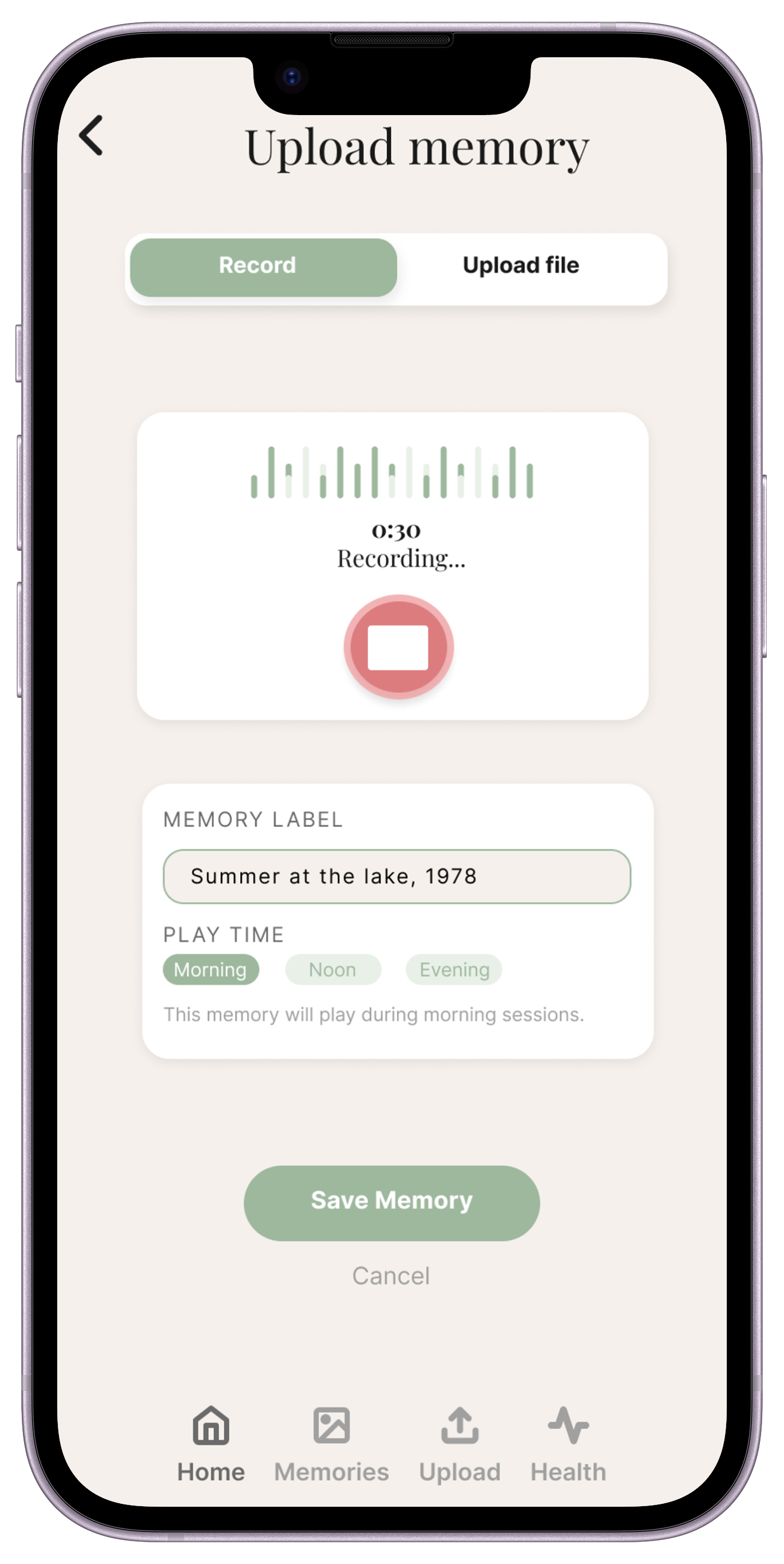
Lumen is a single tactile object the patient keeps with them throughout the day. When held and fidgeted with for 30–60 seconds, it plays short personal voice recordings uploaded by family members.
"Hey Mom, it's Sarah. Do you remember that summer we drove up to the lake house? The one with the red rowboat?"
One of the recordings a family uploads through the appThe ball listens for a response. The interaction is logged. The caregiver gets a quiet notification: Mom had a memory session today.
The Ball
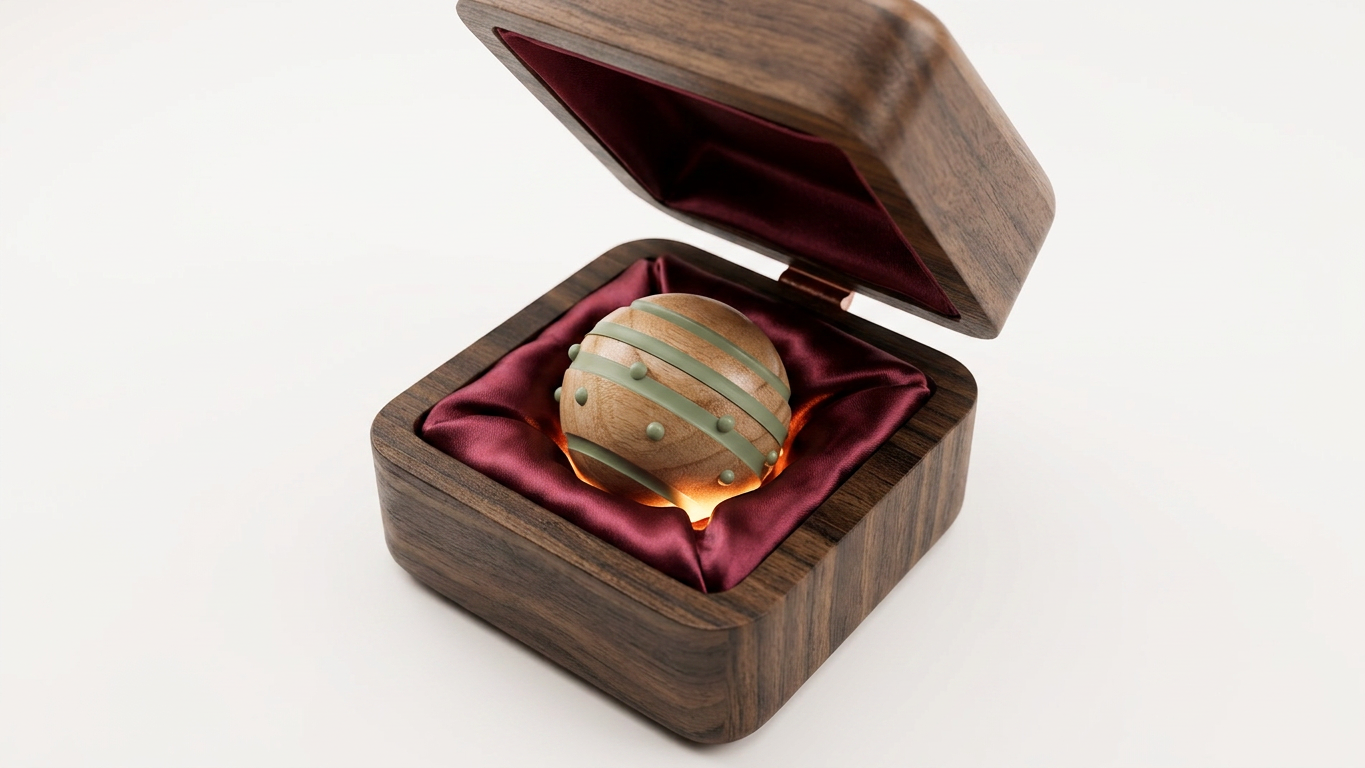
50mm maple wood, warm and smooth to the touch. Three tactile zones guide interaction without any instruction needed.
The Chest
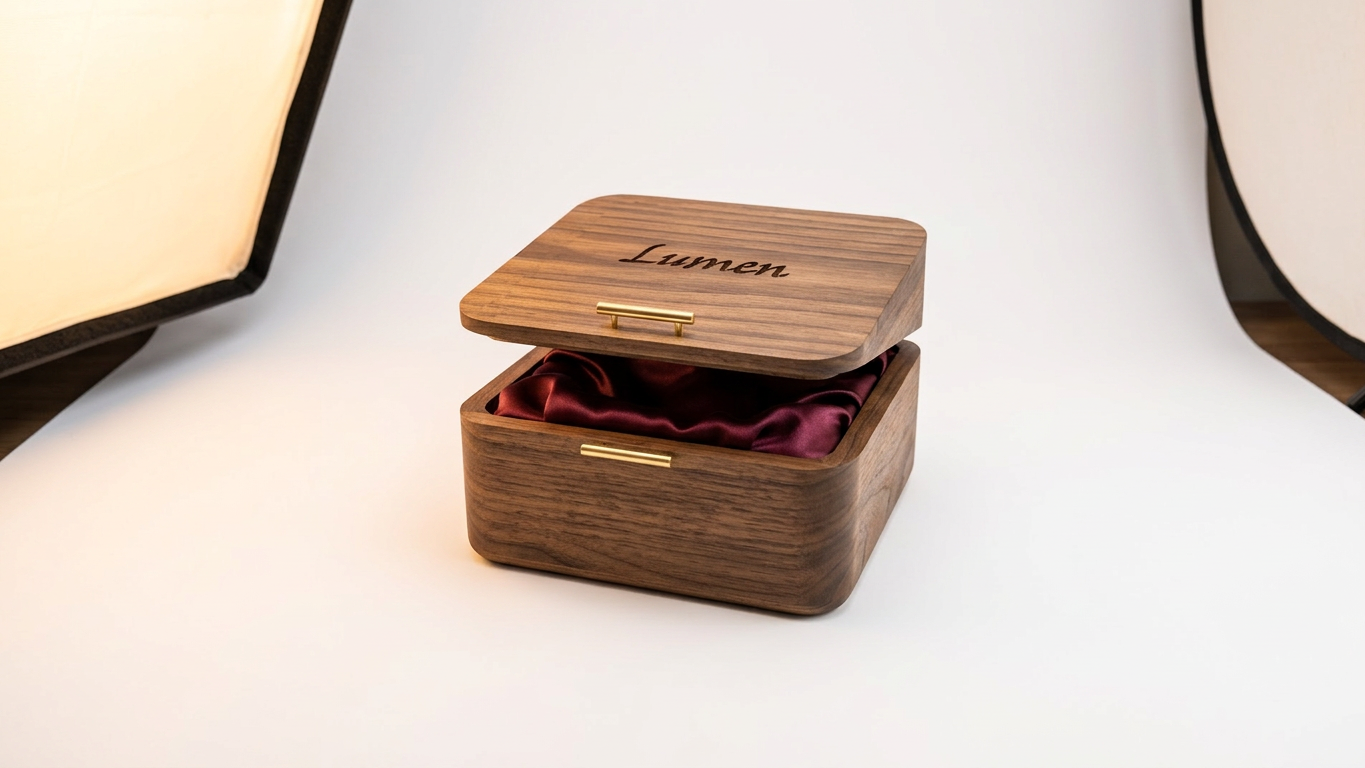
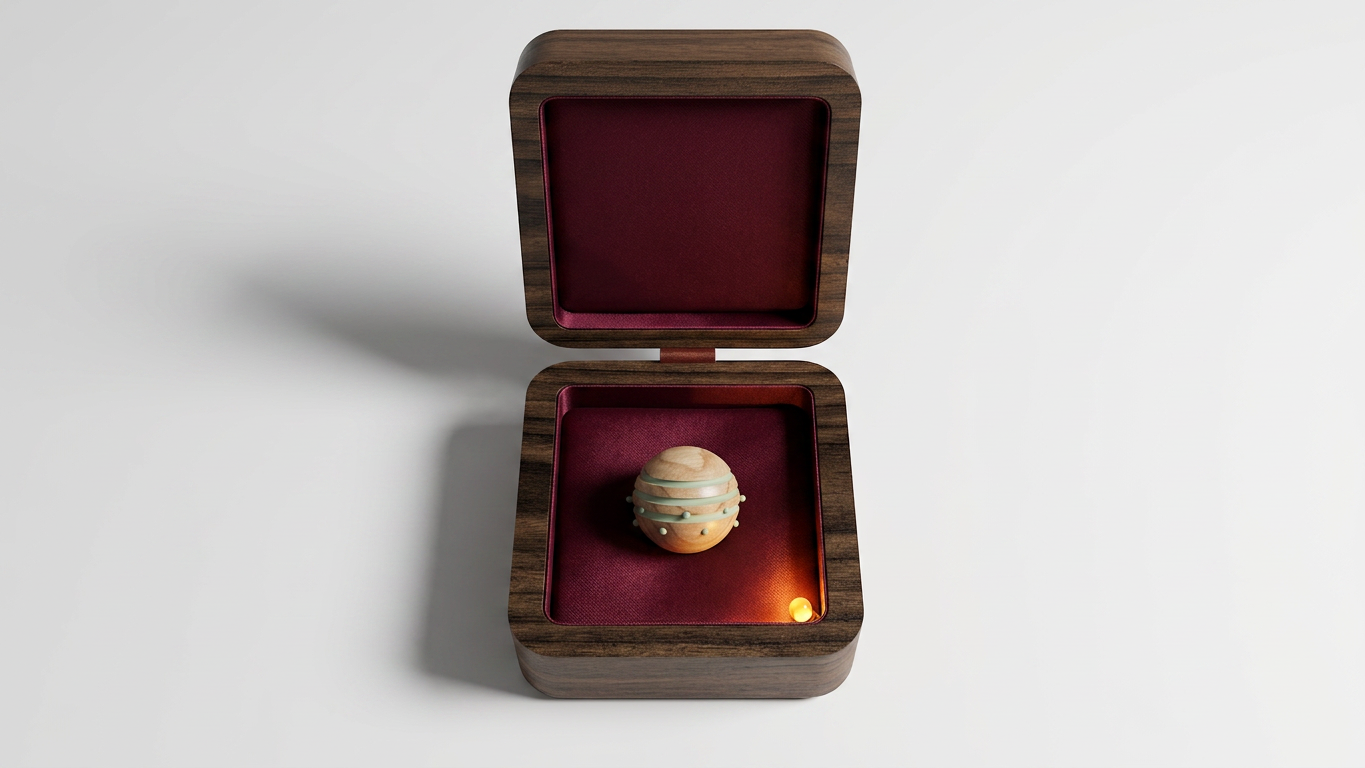
Walnut wood charging case that lives on the bedside table. A beautiful object, not a medical device.
The App
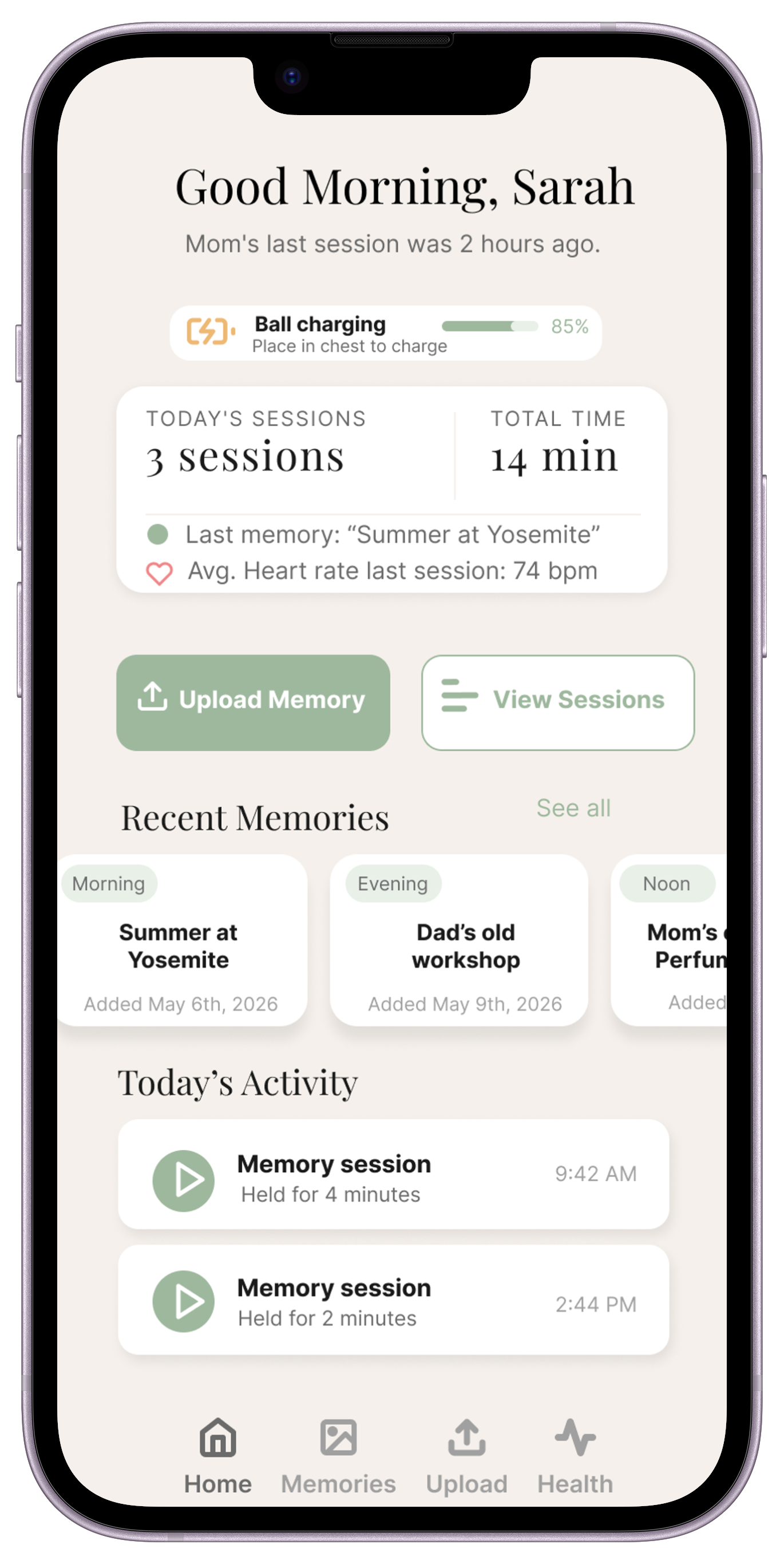
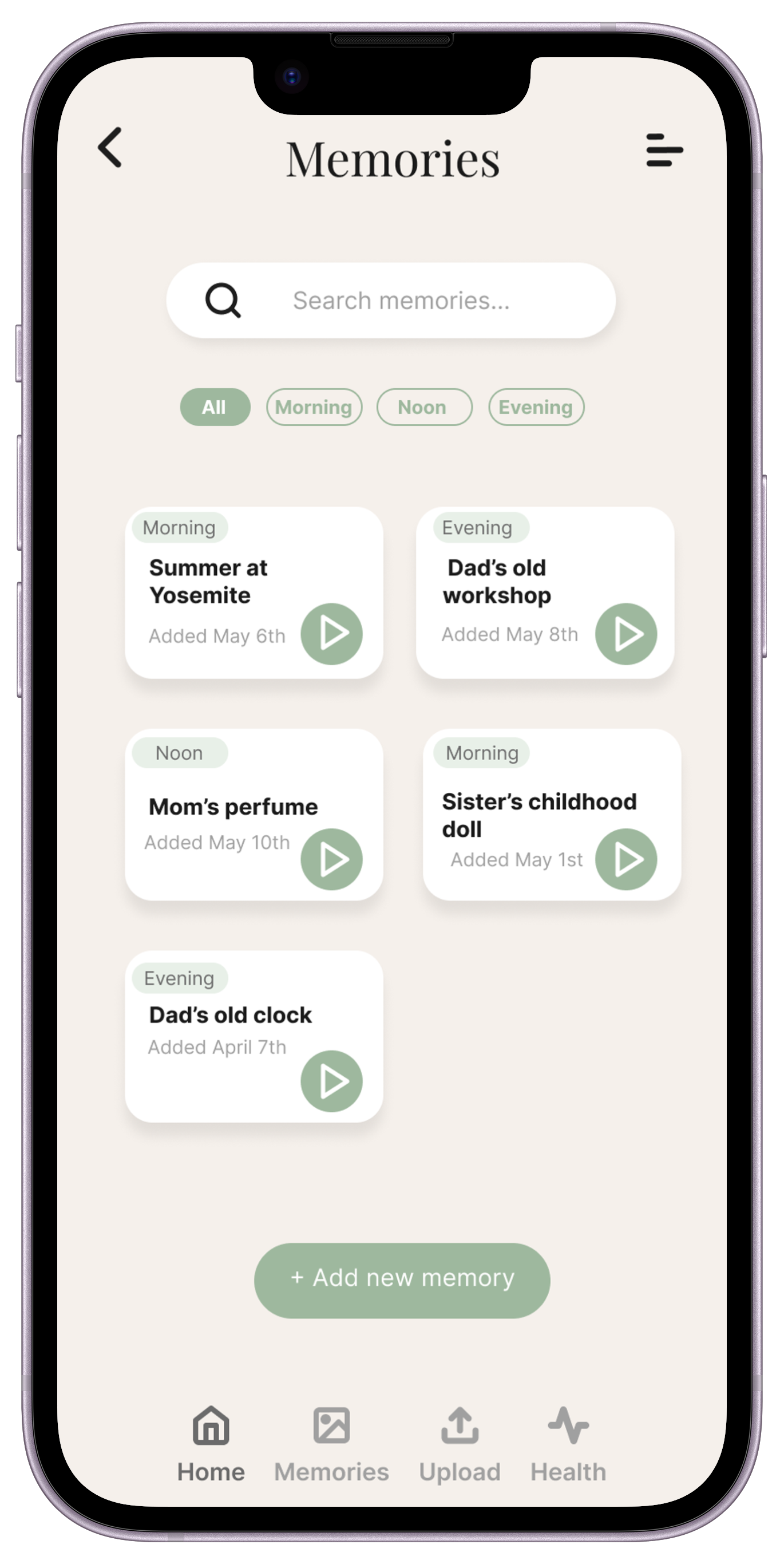
Caregiver-facing companion app for uploading voice recordings and viewing session logs, simple by design, not by accident.
The Data Loop
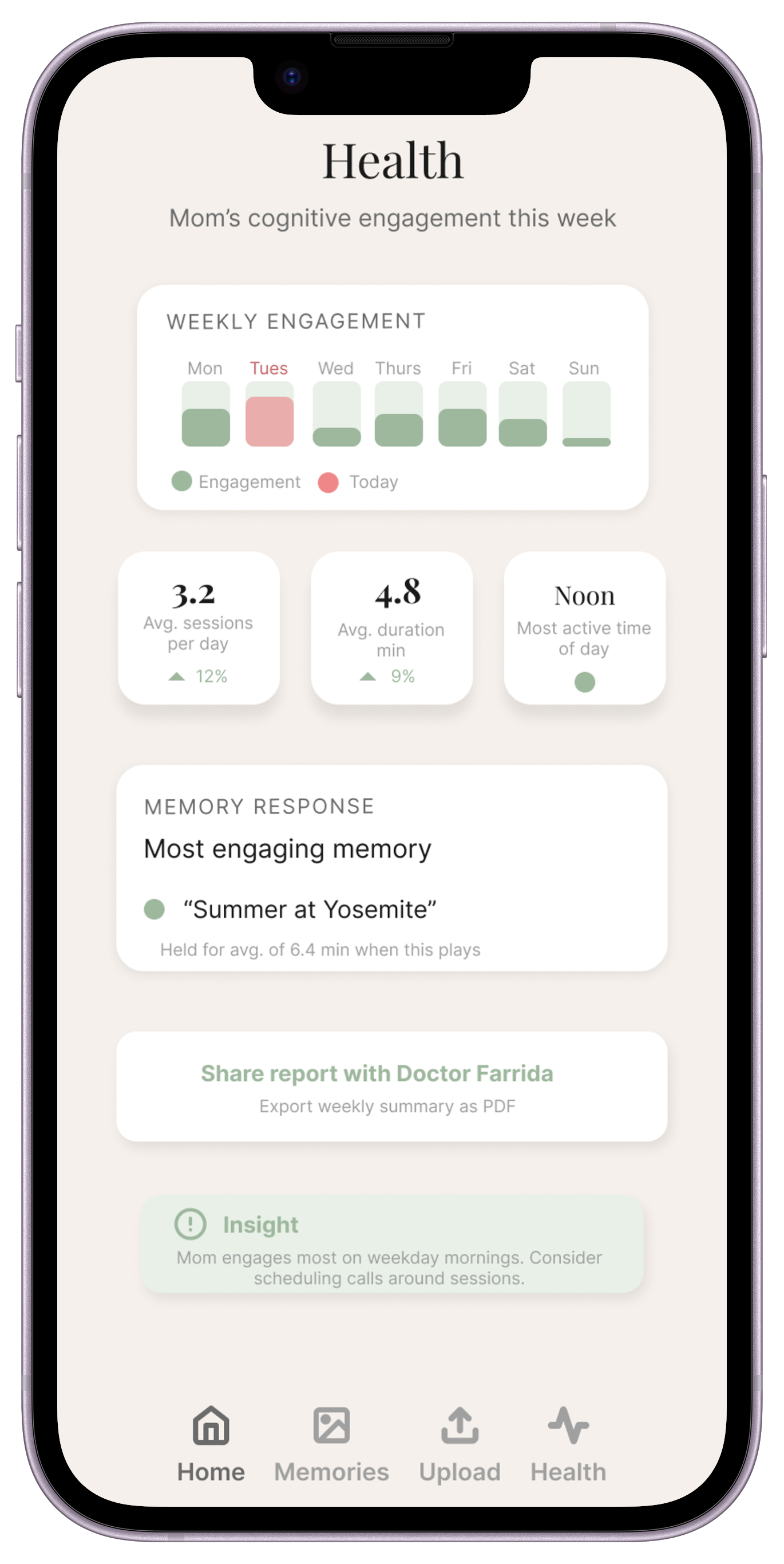
Session logs sync over WiFi overnight. Caregivers see engagement trends. Clinicians can receive weekly summaries directly from the app.
Every decision was earned
Below are the six decisions with the most design reasoning behind them - including the wrong turns that led to each one.
Form - why a ball
Baoding balls - the traditional two-ball hand exercise - were my starting reference, and my first prototype used two. It wasn't until I mocked up the size needed to hold both comfortably that the problem showed up: at that size, the object filled an elderly palm with reduced grip strength, working against the calming effect it was meant to produce. Cutting to one ball at 50mm kept the same rhythmic quality with a fraction of the physical demand.
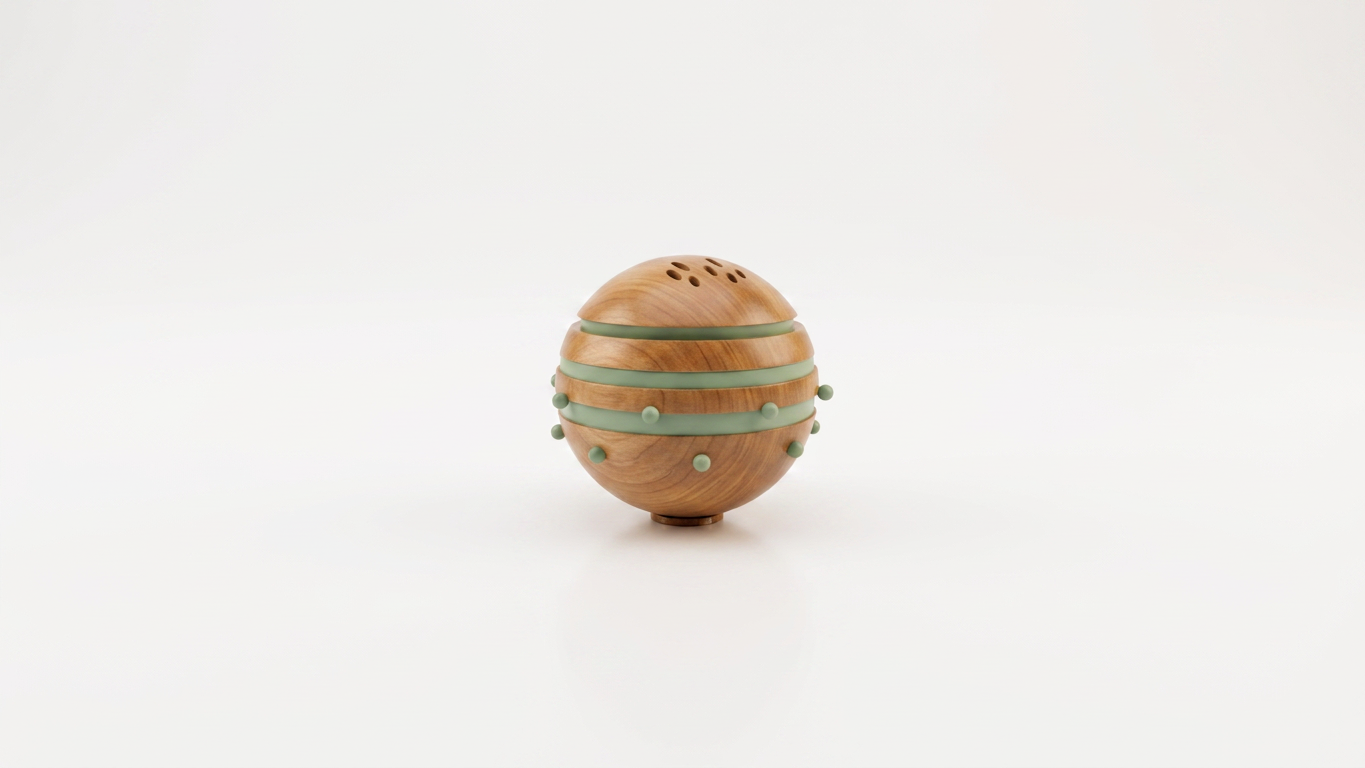
Surface - three tactile zones
The ball has three distinct zones: smooth poles, a raised dot cluster at the equator, and carved horizontal grooves in the lower hemisphere. The grooves solve a hidden orientation problem, fingers naturally settle into them, which means the speaker always faces up without any instruction given to the patient.
Audio - distributed port clusters
My first pass put a single acoustic port at the top of the ball - the natural place for a speaker grille. It worked fine on the bench. It failed the moment I tested it in a closed fist: cupping both hands around the ball, the most natural holding posture for someone anxious or unstimulated, muffled the sound almost completely. The one place I'd put the port was the one place a hand would cover it.
The fix was to stop treating "the port" as singular. Three clusters of 7 drilled holes at 120° intervals mean at least one cluster stays exposed no matter how the ball is held. Visually they read as a constellation rather than a speaker grille - a side effect I hadn't planned for but kept.
Material - from maple to an open question
Maple was my original choice: smooth, warm to the touch, and able to take a fine finish without feeling clinical. Walnut for the chest was chosen to be intentionally darker, so the ball is easy to locate by contrast when placed inside.
My mentor flagged a problem I hadn't priced out: machining a solid 50mm hardwood sphere is expensive regardless of species, and at any kind of manufacturing scale, maple specifically becomes a real budget risk. I don't have a replacement material locked in yet - I'm weighing a cheaper solid wood (beech or ash, which take a finish similarly to maple) against a wood veneer over a molded composite core, which addresses the machining cost more directly but changes the engineering story from solid wood to composite. The chest's walnut is under the same scrutiny, since it's typically pricier than maple, not cheaper.
Still open: the material swap is a real budget constraint from mentor feedback, not yet resolved. I'd rather show this as an active question than pick something I haven't validated.
Color - sage green accents
Research from the Fisher Center for Alzheimer's Research Foundation shows Alzheimer's patients respond best to soft, muted tones. Sage green (R:158, G:185, B:158) was selected for LED and app accents, clinically calming, reads as intentional design rather than medical device. The terracotta in the app was used sparingly to signal caregiver actions without inducing anxiety.
What's inside a 50mm maple ball
Total electronics cost (prototype): ~$30–40, component cost only - this excludes wood machining, chest assembly, labor, and QC. The constraint of a 50mm wooden sphere with a 34mm usable interior forced every hardware decision. Here's what that looked like in practice.
I designed for Qi wireless charging first. It felt like the premium, invisible solution - no connectors, no wear, no exposed contacts to fail. It wasn't until I mocked up the 34mm usable interior with the ESP32, speaker, SD card, and battery in place that the problem became obvious.
The constraint killed Qi entirely - but it forced a better solution. The user experience is identical: set the ball in the chest, it charges. The hardware underneath is far more compact and manufacturable than what I started with.
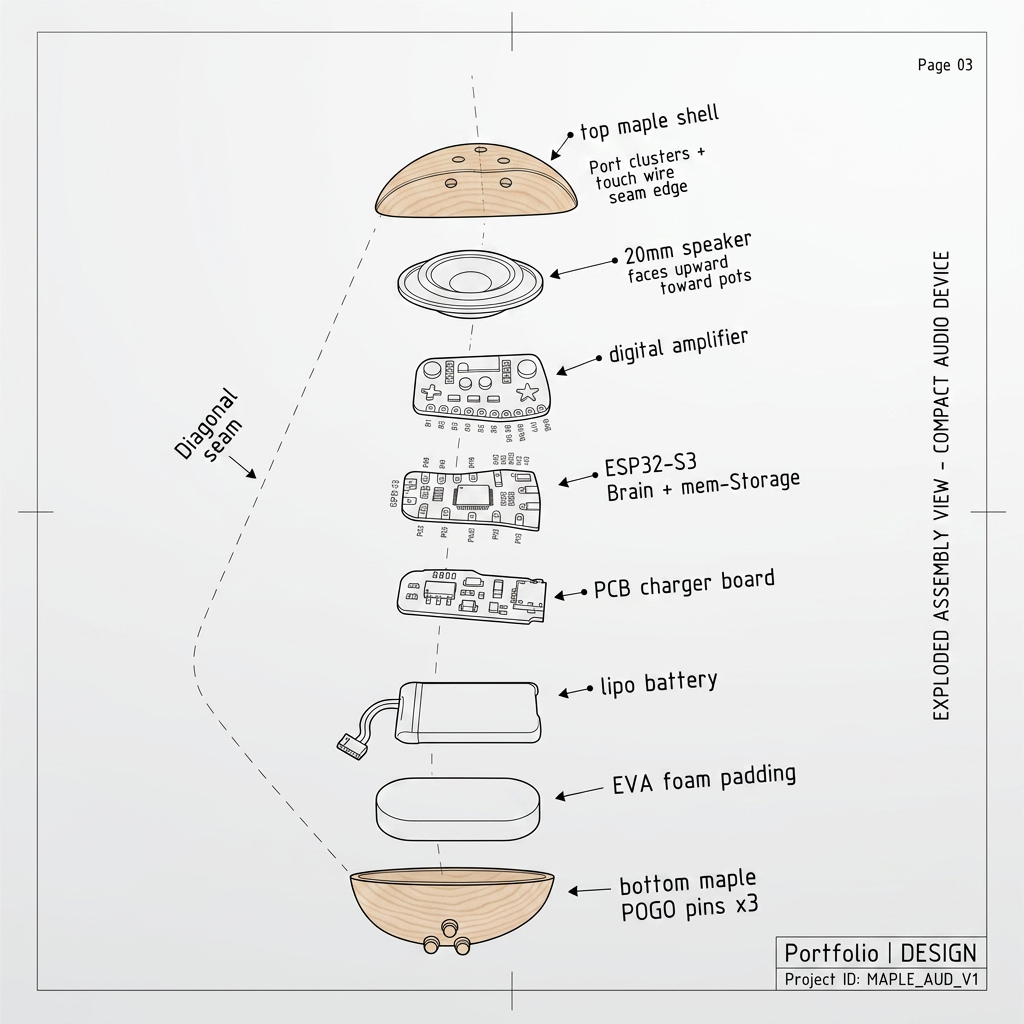
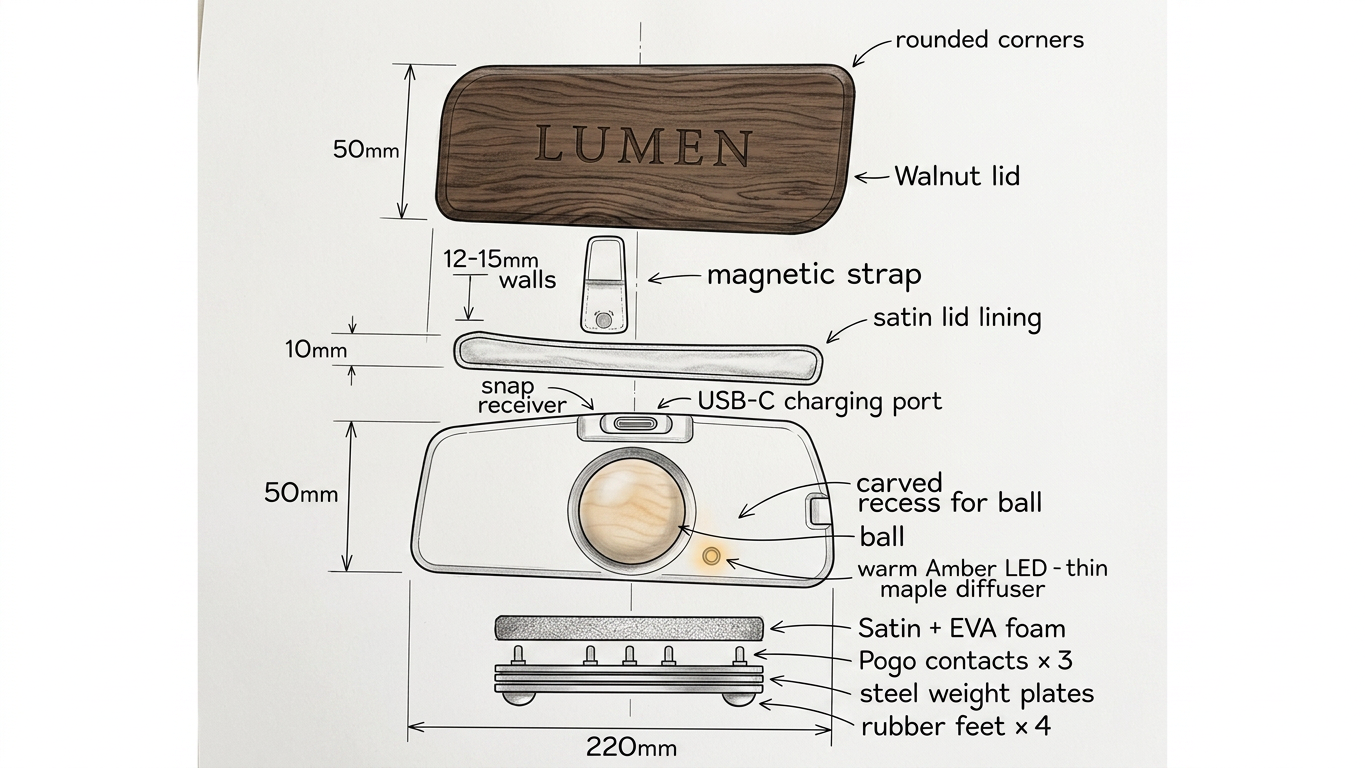
Open question - chip selection: the ESP32-S3 was chosen for its WiFi + BLE support, but the S3 line also includes vector instructions for on-device ML that nothing in Lumen's current spec uses. I don't yet have the embedded hardware experience to confidently say whether a lighter module - an ESP32-C3 or C6, both RISC-V with WiFi + BLE at lower cost and power draw - would serve the same function for less. This is a gap I want a hardware-focused collaborator to help close before finalizing the BOM.
Designed for the caregiver, not the patient
The companion app is intentionally simple - but that simplicity was a design decision, not a shortcut. Caregivers managing a parent with Alzheimer's are already overwhelmed. Every feature that wasn't added was a deliberate choice.
What I omitted - and why
What this project taught me
The best assistive technology disappears
The patient should never feel like they're using a device. Every decision - maple wood, no screen, no buttons, no instructions - was in service of that goal.
Hardware constraints are design constraints
The pogo pin pivot wasn't a compromise - it was a better solution. A 50mm shell forced decisions that made the product simpler, smaller, and more elegant.
Designing for zero UI
This project forced me to think about interaction without a display. Every behavior had to be legible through touch, sound, or physical affordance alone.
Restraint in the app is a feature
Choosing what not to build - no live audio, no scoring, no constant push notifications - was as hard as the decisions I made. The app is simple because trust matters more than dashboards.
What I'd do differently, and where this goes next
If I started Lumen over, I'd pull the material and manufacturing conversation forward instead of running it after the fact. Maple and walnut were chosen for how they felt in the hand and how well they'd contrast inside the charging chest - reasonable instincts, but ones I hadn't priced against manufacturing scale until my mentor flagged it. I'd rather have entered that trade-off with real cost numbers from the start than treat it as an open question this late in the process.
The same is true of the chip selection. The ESP32-S3 does everything Lumen needs, but I chose it before I fully understood what it was for - its on-device ML capability is spec the current design doesn't use. I don't yet have the embedded hardware background to confidently right-size that choice myself, and next time I'd bring in a hardware-focused collaborator earlier, before the component was already load-bearing in the design, rather than after.
Where this goes next is a version of Lumen that senses more without asking the patient to do anything differently. Passive heart rate sensing through palm contact - optical PPG, not a wristband or patch - would let the object pick up on stress the same passive way it already delivers memory. Memory selection could adapt to time of day, detected stress, and what's worked in past sessions, instead of playing recordings in a fixed rotation. The charging LED could live inside the wood grain itself, visible only when active, so the object stays quiet until it has something to say. And for care facilities managing multiple residents, a caregiver API would let session data aggregate anonymously across patients - useful for staff, without turning any one patient's day into a dashboard.